
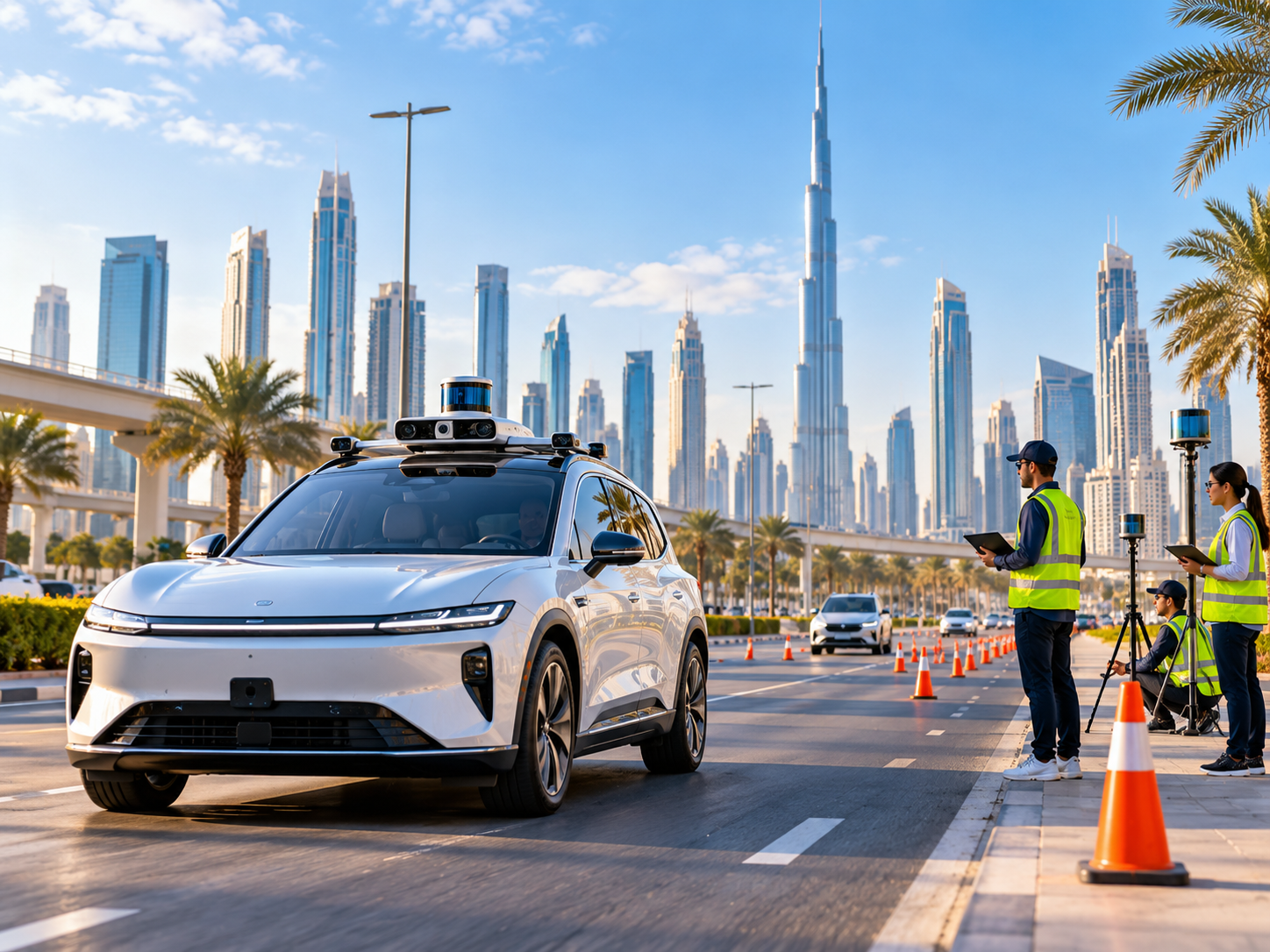
Dubai Launches Dubai Mobility Labs to Accelerate Autonomous Mobility Testing and Deployment
Background
Dubai has taken another step forward in the development of autonomous and future mobility.
On 27 September 2026, Dubai’s Roads and Transport Authority (RTA), in collaboration with the Dubai Integrated Economic Zones Authority (DIEZ), inaugurated Dubai Mobility Labs (DML) at Dubai Silicon Oasis.
The facility is dedicated to autonomous and future mobility technologies, providing an integrated environment for development, testing, validation and certification.
It also forms an important part of Dubai’s broader future mobility testing infrastructure.
PART 01
248 Testing Scenarios: From Controlled Environments to Real-World Roads
A key feature of Dubai Mobility Labs is the combination of controlled testing environments and real-world public-road conditions.
The overall testing ecosystem covers 248 testing scenarios, including dedicated test tracks, controlled testing areas and selected public-road environments.
These scenarios allow developers to assess autonomous vehicles in areas including:
- sensing and environmental perception;
- decision-making and response;
- interaction with other road users; and
- adaptation to changing traffic and environmental conditions.
Dubai Mobility Labs is more than a conventional closed proving ground.
According to publicly available information, its testing environment can extend to selected public roads from Dubai Silicon Oasis towards Al Qudra, allowing autonomous technologies to be assessed under conditions closer to real-world traffic.
This progression from controlled environments to public-road conditions can support further evaluation of safety, reliability and operational readiness under increasingly complex scenarios.
International Companies Have Already Participated in Testing
According to published information, autonomous driving technologies and vehicles developed by international companies including WeRide, Pony.ai and Tesla have already undergone testing at Dubai Mobility Labs.
International testing, inspection and certification organisation DEKRA has also been appointed by RTA to manage and operate the facility.
DEKRA describes the site as a professional proving ground for ADAS and autonomous driving technologies, supporting activities from early-stage development and verification through validation and certification.
PART 02
Supporting Dubai’s 2030 Autonomous Mobility Strategy
The launch of Dubai Mobility Labs also supports Dubai’s long-term Smart Self-Driving Transport Strategy.
Dubai’s stated long-term target is to convert 25% of all mobility journeys into autonomous trips by 2030, a goal that RTA continues to reaffirm as part of its future mobility strategy.
At the same time, Dubai has continued to advance autonomous taxis, road testing of autonomous vehicles and supporting smart transport infrastructure, gradually expanding both the testing and practical application of future mobility technologies.
Dubai Mobility Labs should therefore be viewed not as an isolated testing initiative, but as part of Dubai’s broader future mobility strategy.
CA Perspective
From CA’s perspective, the significance of Dubai Mobility Labs goes beyond the establishment of another autonomous vehicle testing facility.
More importantly, Dubai is gradually connecting:
- policy objectives;
- testing infrastructure;
- international technology companies;
- professional testing and certification organisations; and
- real-world road environments.
This is helping strengthen the supporting conditions for the testing, validation and eventual commercial deployment of future mobility technologies.
Public information also indicates that the facility is intended to provide a more structured environment for technology development, validation and testing, while encouraging greater collaboration among government entities, technology companies, research institutions and specialised organisations.
RTA has also stated that the project aims to establish an integrated ecosystem connecting vehicle manufacturers, technology developers, startups, research institutions and regulators.
For automotive, technology and future mobility companies looking at the Middle East, developments of this nature are worth monitoring closely.
They reflect not only continued policy support for emerging technologies, but also the ongoing development of the infrastructure, testing capabilities and ecosystem required to support them.
The key question going forward is therefore not simply whether Dubai supports autonomous mobility, but:
How quickly can its testing infrastructure, regulatory framework, technology ecosystem and real-world deployment environments develop into a scalable commercial mobility ecosystem?