
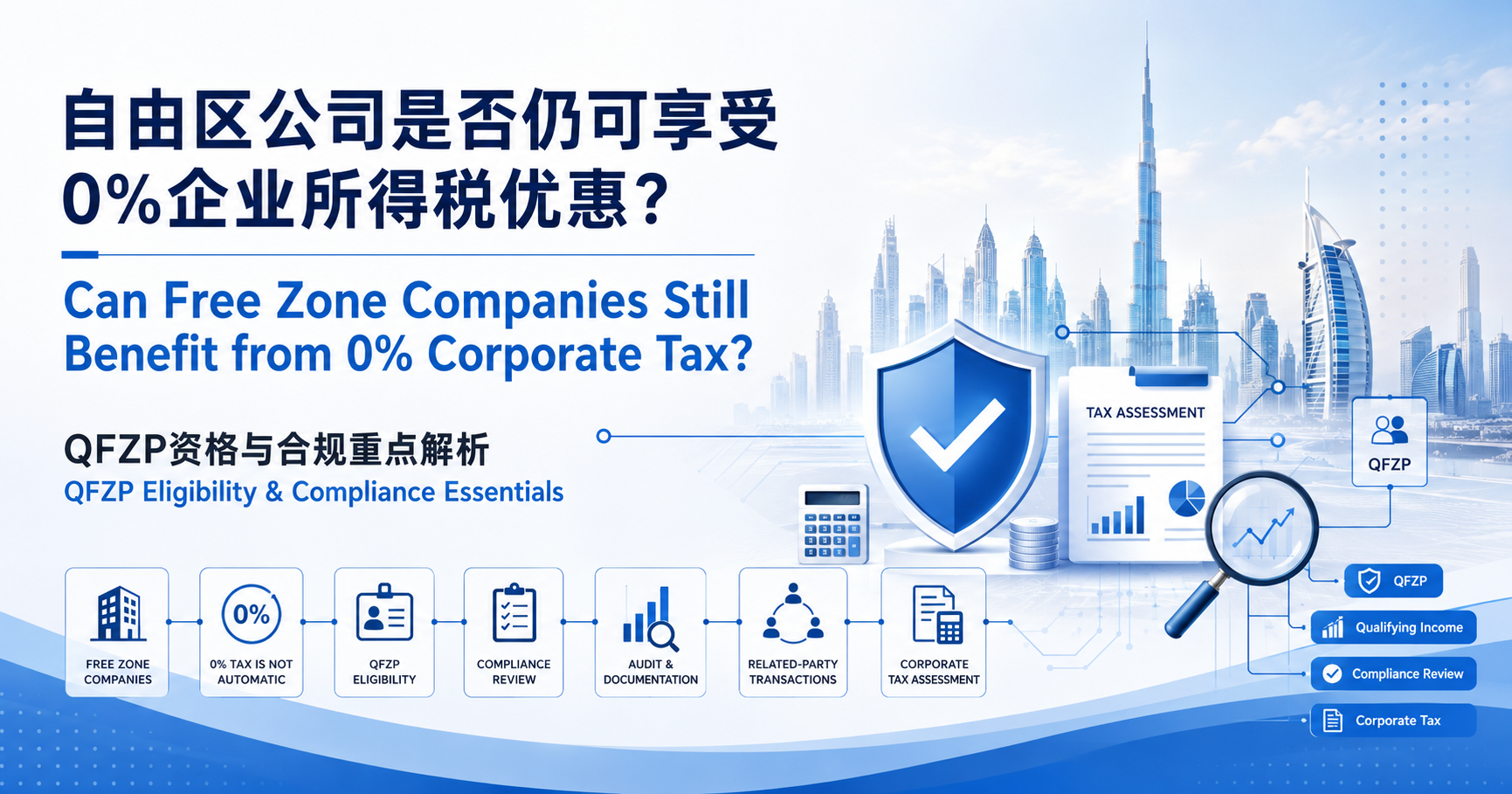
Can a Free Zone Company Still Benefit from the UAE’s 0% Corporate Tax Rate? Key QFZP Considerations for Businesses
Since the implementation of the UAE Corporate Tax regime, we have observed that an increasing number of businesses have begun reassessing the Corporate Tax position of their Free Zone entities, particularly as their business operations expand, their group structures evolve, or they plan to enter the UAE mainland market.
A common question we hear is:
“Our company is incorporated in a UAE Free Zone, such as DIC, DMCC, JAFZA, DIFC, DAFZA, DWTC or ADGM. Can we still benefit from the UAE’s 0% Corporate Tax regime?”
Many businesses continue to assume that:
“As long as a company is established in a UAE Free Zone, it automatically enjoys a 0% Corporate Tax rate.”
However, this remains one of the most common misconceptions among businesses.
Under the UAE Corporate Tax Law and its implementing regulations, Free Zone companies do not automatically qualify for the UAE Free Zone Corporate Tax incentives. Only companies that satisfy the prescribed requirements and qualify as a Qualifying Free Zone Person (QFZP) may apply the 0% Corporate Tax rate to their Qualifying Income.
01 What is a Qualifying Free Zone Person (QFZP)?
A Qualifying Free Zone Person (QFZP) is a key concept under the UAE Corporate Tax regime and forms the basis for determining whether a Free Zone company may benefit from the preferential corporate tax treatment.
A QFZP is not a separate licence, permit or approval. Rather, it is a tax status available to eligible Free Zone Persons that satisfy the prescribed conditions under the UAE Corporate Tax regime.
In simple terms, not every Free Zone company automatically qualifies as a QFZP. A business must continuously satisfy the applicable statutory conditions before it may benefit from the preferential corporate tax treatment in respect of its Qualifying Income.
Failure to continuously satisfy the relevant requirements may result in some or all of the company’s income no longer qualifying for the Free Zone Corporate Tax incentives and becoming subject to the UAE Corporate Tax regime, as applicable.
02 How Can Businesses Assess Whether They Meet the QFZP Requirements?
The following five areas deserve particular attention:
1. Does the Company Have Sufficient Economic Substance?
Businesses should consider whether the company has:
- Physical office premises in the UAE;
- An adequate number of employees commensurate with its business activities;
- Appropriate operating expenditure to support its business operations;
- Effective management and key business decisions undertaken in the UAE.
Businesses should demonstrate genuine commercial operations in the UAE, including physical premises, employees, operating expenditure, and effective management within the UAE.
A shell company with little or no commercial substance is unlikely to satisfy the relevant requirements.
2. Does the Company Earn Qualifying Income?
This is one of the most frequently overlooked factors when assessing whether a business remains eligible for the 0% Corporate Tax benefit.
Not all income is eligible for the 0% Corporate Tax rate. Whether income constitutes Qualifying Income should be assessed based on the nature of the business, the counterparties involved, the transaction arrangements, and the applicable provisions of the UAE Corporate Tax legislation.
Accordingly, even if two companies hold the same business licence and operate in similar industries, their Corporate Tax treatment may differ depending on their actual business model and the nature of their income.
3. Are Audited Financial Statements Properly Prepared?
Maintaining proper accounting records and audited financial statements is generally an important compliance requirement for businesses seeking to maintain QFZP status.
Companies should ensure that accounting records are properly maintained, financial information is complete, and annual audited financial statements are prepared where required.
4. Does the Company Engage in Related-Party Transactions?
Transactions with related parties are another key area of focus under the UAE Corporate Tax regime.
Examples of related-party transactions within a corporate group may include:
- Service fees;
- Management fees;
- Technical service fees;
- Shareholder loans;
- Cross-border procurement or sales;
- Royalty payments;
- Intra-group financing arrangements.
Where such transactions exist, businesses should ensure compliance with the UAE Transfer Pricing rules. Related-party transactions should be conducted in accordance with the Arm’s Length Principle, and businesses should maintain appropriate supporting documentation and prepare Transfer Pricing documentation where required under the applicable regulations.
5. Does the Company Continue to Meet the QFZP Eligibility Requirements?
QFZP status is not a one-time qualification. Businesses are required to continuously satisfy the relevant requirements under the UAE Corporate Tax legislation and periodically assess whether their business model remains eligible for QFZP status.
Businesses should reassess their Corporate Tax position whenever there are significant changes to their business operations, including:
- Commencing business activities with the UAE mainland market;
- Introducing new business activities or expanding the scope of existing operations;
- Restructuring the group or shareholding structure;
- Introducing or expanding related-party transactions;
- Developing new revenue streams or business models.
Regular Corporate Tax reviews are recommended to help businesses maintain ongoing QFZP eligibility and minimise potential tax and compliance risks.
03 CA Insight
As businesses continue to grow, Corporate Tax implications often arise not only at the incorporation stage, but more commonly as a result of business expansion, group restructuring, changes to operating models, or the introduction of new business activities.
For businesses that are restructuring their group, optimising their operating model, or planning to commence activities in the UAE mainland market, we recommend conducting a Corporate Tax Impact Assessment before implementing such changes, rather than reassessing the tax implications only when preparing the annual Corporate Tax return.
Identifying potential tax and compliance risks at an early stage enables businesses to optimise their operational arrangements, reduce future tax and compliance costs, and enhance tax certainty and predictability.
04 What Could Affect the 0% Corporate Tax Benefit?
Based on our experience advising businesses in the UAE, companies should pay particular attention to the following situations:
- A Free Zone company starts conducting business with the UAE mainland market;
- New business activities are added without evaluating the Corporate Tax implications;
- Related-party transactions increase within the group;
- Annual audited financial statements are not prepared as required;
- The company’s operating model changes significantly;
- The company assumes that Free Zone status permanently guarantees a 0% Corporate Tax rate without ongoing compliance.
These changes may affect a company’s Corporate Tax compliance and eligibility for the applicable Free Zone tax incentives. Businesses are therefore encouraged to conduct periodic Corporate Tax Health Checks to identify potential risks and ensure ongoing compliance.
05 CA Recommendation
As the UAE Corporate Tax framework continues to evolve, “Free Zone = 0% Corporate Tax” is no longer a simple equation.
The key consideration is whether the company continues to satisfy the requirements to qualify as a Qualifying Free Zone Person (QFZP) and whether its business model remains eligible for the applicable Free Zone Corporate Tax incentives.
Businesses planning to enter the UAE market, or those already operating in Free Zones such as DIC, DMCC, JAFZA, DIFC, DAFZA, DWTC or ADGM, are encouraged to conduct periodic Corporate Tax and compliance reviews to ensure continued compliance with the applicable regulations.
06 How CA Can Assist
Corridors Advisory can assist businesses with:
- Corporate Tax registration;
- QFZP eligibility assessment;
- Corporate Tax compliance review;
- Accounting and audit coordination;
- Annual compliance and corporate secretarial services;
- Company incorporation and corporate structuring.
Please feel free to contact Corridors Advisory if you would like to assess your company’s eligibility for the UAE Free Zone Corporate Tax incentives or require tailored professional advice.
Disclaimer
This publication is provided for general information purposes only and does not constitute legal, tax, accounting or other professional advice. Eligibility for the Qualifying Free Zone Person (QFZP) regime depends on the specific facts and circumstances of each business and the applicable UAE legislation. Professional advice should be obtained before making any business or tax decisions.