ICBC Dubai Lists Dual-Currency Green Bonds on Nasdaq Dubai
Background
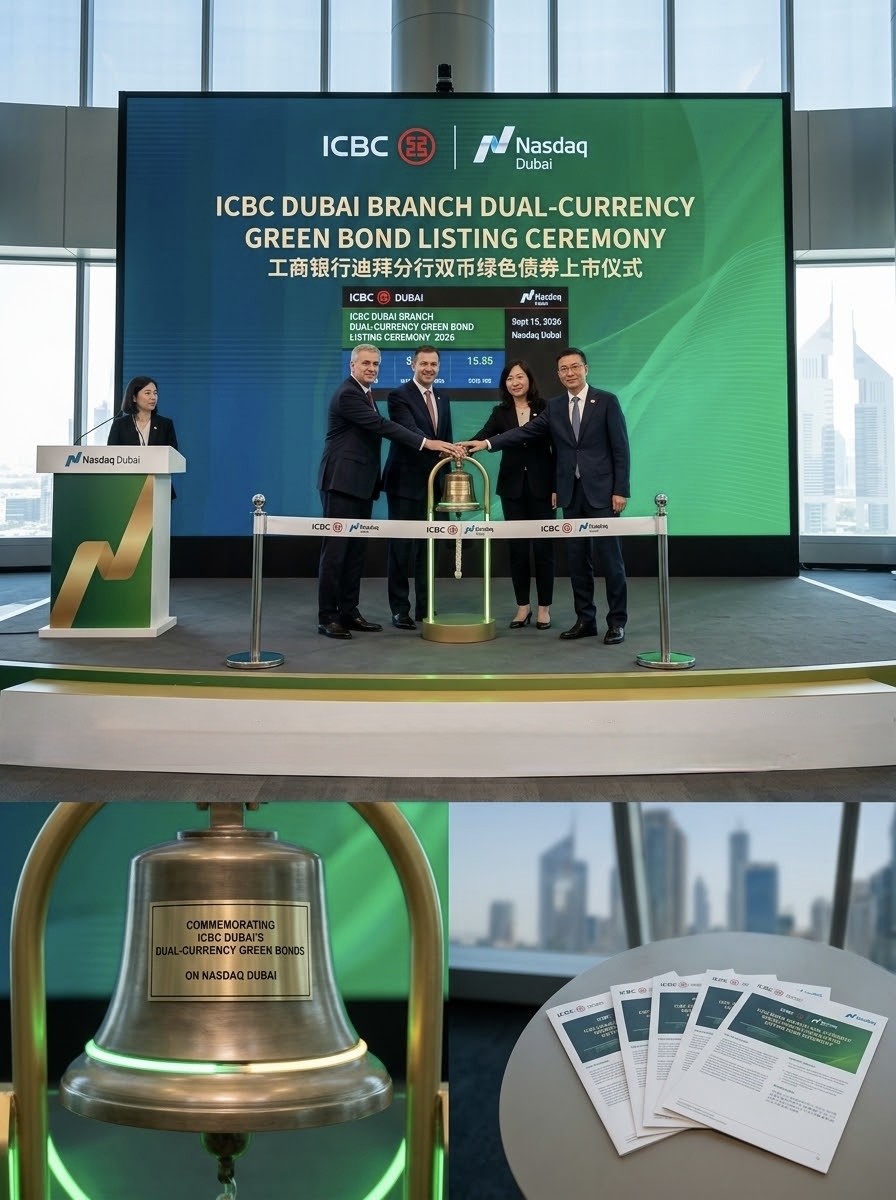
Industrial and Commercial Bank of China Limited (ICBC), through its Dubai (DIFC) Branch, has listed dual-currency green bonds on Nasdaq Dubai.
According to information published by Nasdaq Dubai / Dubai Financial Market, the issuance has a total value of approximately USD 713 million, forms part of ICBC’s USD 20 billion Global Medium Term Note Programme, and carries the theme of “China-Arab States Renewable Energy Cooperation.”
The issuance consists of two tranches:
- USD 300 million three-year floating-rate notes, priced at SOFR + 35 basis points; and
- CNH 2.8 billion fixed-rate bonds, equivalent to approximately USD 413 million.
ICBC had also previously disclosed through its official Investor Relations channel that its Dubai (DIFC) Branch was issuing notes under the USD 20 billion Global Medium Term Note Programme.
1. Proceeds Support Green and Sustainable Projects
According to Nasdaq Dubai, proceeds from the green bonds will be allocated to projects related to:
- carbon neutrality;
- renewable energy; and
- sustainable infrastructure.
Xinhua further reported that the proceeds will support low-carbon renewable energy projects in China and Arab countries.
This is consistent with the issuance theme of “China-Arab States Renewable Energy Cooperation.”
2. Strong Demand from International and Regional Investors
The issuance attracted strong demand from international and regional investors.
The USD tranche was approximately 3.8 times oversubscribed, with an order book of around USD 1.2 billion.
The CNH tranche was approximately 3.5 times oversubscribed, with an order book of around CNH 10 billion.
Following this listing, ICBC has approximately USD 4.24 billion in outstanding bonds across four issuances on Nasdaq Dubai.
3. Dubai Continues to Develop as an International Debt Capital Market Platform
At the time of the announcement, total outstanding debt securities listed on Nasdaq Dubai had exceeded approximately USD 143.9 billion, including:
- approximately USD 98.4 billion in Sukuk;
- approximately USD 45.4 billion in conventional bonds; and
- approximately USD 27.5 billion in ESG-related listings.
The transaction further illustrates Dubai’s role as a platform for international debt capital markets and cross-border financing.
To mark the listing, H.E. Zeng Jixin, Ambassador of the People’s Republic of China to the UAE, attended the market-opening bell ceremony together with representatives from Nasdaq Dubai / DFM and ICBC Dubai (DIFC) Branch.
What Can We Observe from This Transaction?
The significance of this development extends beyond the listing of a single bond issuance.
Based on this transaction and publicly available information, several broader points are worth observing.
1. Dubai Continues to Play a Role as an International Debt Capital Market Platform
The listing of ICBC Dubai (DIFC) Branch’s dual-currency green bonds on Nasdaq Dubai provides another example of an international financial institution using Dubai’s capital market infrastructure for cross-border financing.
Nasdaq Dubai already has a significant volume of Sukuk, conventional bonds and ESG-related debt securities.
ICBC’s latest listing can therefore be viewed as another example within the continuing development of Dubai’s international debt capital market.
2. The Use of RMB in Regional Capital Markets Is Worth Watching
The issuance included not only a USD tranche, but also a CNH 2.8 billion offshore RMB tranche.
In China-Arab economic and trade relations, RMB is often discussed in connection with:
- trade settlement;
- cross-border payments; and
- banking services.
This transaction provides a practical example of RMB also being used in regional debt financing and capital market products.
Xinhua reported that, following this listing, ICBC’s cumulative issuance of RMB-denominated bonds on Nasdaq Dubai has exceeded RMB 10 billion.
Whether this develops into a broader market trend will require further observation, but the examples themselves are worth monitoring.
3. China-Arab Financial Cooperation Is Appearing in More Diverse Forms
Traditionally, China-Arab financial connectivity is often associated with:
- trade finance;
- cross-border settlement;
- banking services; and
- project financing.
This green bond issuance, themed around “China-Arab States Renewable Energy Cooperation,” provides another example involving:
- capital markets;
- green financing; and
- RMB-denominated financial products.
Rather than treating a single transaction as evidence of a major structural shift, it may be more appropriate to view it as another example of the increasingly varied forms of China-Arab financial cooperation.
4. DIFC’s Role Is Not Limited to Company Formation
For many Chinese businesses, DIFC may first be associated with:
- company establishment;
- financial licensing;
- wealth structuring; or
- international business platforms.
However, the bonds in this transaction were issued through ICBC Dubai (DIFC) Branch, which also illustrates another aspect of DIFC’s role as an international financial centre.
It is important to distinguish this from ordinary corporate establishment in DIFC.
International bond issuance by a major financial institution is very different from setting up a standard corporate entity.
The broader relevance of this case is therefore to help businesses better understand DIFC’s place within Dubai’s financial ecosystem and its connectivity with international capital markets, rather than suggesting that establishing a company in DIFC automatically provides access to international bond issuance.
5. Green and Sustainable Finance Continues to Appear in Regional Capital Markets
The proceeds from this issuance are linked to:
- carbon neutrality;
- renewable energy;
- low-carbon projects; and
- sustainable infrastructure.
Nasdaq Dubai’s official data also shows that ESG-related listings currently amount to approximately USD 27.5 billion.
Based on these publicly available figures, green and sustainable finance continues to be a visible theme within regional debt capital markets.
For businesses involved in:
- renewable energy;
- infrastructure;
- industrial transition; or
- sustainability-related projects,
such developments are worth monitoring.
However, the availability and suitability of any particular financing method will depend on factors including:
- company scale;
- credit profile;
- project characteristics;
- financing structure; and
- regulatory requirements.
CA Perspective
From CA’s perspective, the value of this transaction lies less in the bond issuance itself and more in what it illustrates about Dubai’s broader financial ecosystem.
For businesses assessing the UAE and the wider Middle East market, Dubai may provide access to a combination of:
- international banking;
- cross-border financing;
- capital markets;
- regional business platforms; and
- professional services.
For Chinese enterprises in particular, the increasing diversity of China-UAE financial cooperation may create more structuring and financing possibilities over time.
At the same time, financing structures should not be selected solely on the basis of market examples.
Businesses should assess their own:
- business model;
- ownership structure;
- financing objectives;
- credit profile;
- regulatory status; and
- long-term development plans
before determining an appropriate financing or corporate structure.
Corridors Advisory (CA) can assist businesses in reviewing UAE market-entry structures, corporate structuring, banking arrangements, cross-border setup and related compliance considerations.